
Air Filtration & HEPA Scrubbing in San Jose: Clean, Safe Air After Mold, Fire, or Flood Damage
After mold remediation, sewage cleanup, or fire damage, airborne spores and particulate linger long after visible contamination is gone. We pair on-site moisture and air quality testing with commercial HEPA scrubbing to clear what you can not see — using proper containment before any equipment runs.
What's Covered on This Page
Signs You Need Professional Air Filtration and HEPA Scrubbing
Quick Summary:A musty smell that won't go away, dust that returns within days of cleaning, or breathing trouble after water damage are all signs your air needs professional attention. HEPA air scrubbing matters most after mold remediation, sewage cleanup, or when a crawl space has stayed damp for a while.
Most people do not think about their air until something feels off. Maybe it is a smell that lingers no matter how many candles you burn. Maybe allergies flare up worse indoors than outside. These are signs worth taking seriously.
Common Signs Your Air Needs Professional Attention:
- A musty or damp smell that comes back within a day or two of airing the house out.
- Visible mold on drywall, baseboards, or in a crawl space after a leak.
- Dust or fine particles settling on surfaces again shortly after cleaning.
- Coughing, headaches, or sinus irritation that eases when you leave the house.
- Recent sewage backup, black water intrusion, or a slow leak that sat unnoticed for weeks.
Mold spores and sewage particles do not stay put. They travel through your HVAC system and settle in rooms you never had a problem in. We see this constantly after a hidden pipe leak gets discovered too late. If your home just went through mold remediation or a sewage cleanup, HEPA air scrubbing clears out what containment and antimicrobial treatment leave floating in the air. Skip it, and you are breathing the aftermath for weeks.
Not every musty smell means a big problem. Sometimes it is just a closed-up room needing airflow. But if the smell traces back to water damage, or you have had mold removed and still feel stuffy indoors, an air freshener will not fix it.
Wildfire Season and Indoor Air Risk in San Jose
San Jose's air quality risk is not hypothetical during late summer and fall. Wildfire activity across Northern California between August and November consistently pushes South Bay outdoor Air Quality Index readings into unhealthy or very unhealthy categories — sometimes for days at a stretch.
Unlike a burst pipe or a roof leak, this is not a single-event emergency. It is a recurring seasonal pattern that fills homes with fine particulate matter (PM2.5) before residents notice a visible haze indoors. Smoke infiltration does not require standing water or a moisture source. It requires open windows, door gaps, aging weatherstripping, and an HVAC system pulling outdoor air through a filter that was never rated for combustion particulate.
Housing stock plays a direct role. Many South Bay neighborhoods — from Willow Glen to parts of Almaden and the older sections near downtown — are built on mid-century through 1970s construction. Standard 1-inch fiberglass or low-MERV filters common in older HVAC setups do little to stop PM2.5 sized smoke particles. This means smoke odor and haze can settle into carpets, drywall, and HVAC ductwork even when doors and windows stay closed.
What to Check During a Regional Fire Incident:
- Check current and forecasted AQI for the San Jose area during active fire incidents — not just visible smoke at your address.
- Confirm whether your HVAC system's filter is MERV 13 or higher; lower ratings will not capture wildfire smoke particulate.
- Look for lingering smoke odor in fabric, carpet, and ductwork days after outdoor air quality improves — this signals particulate has settled indoors.
- Treat homes built before the 1980s as higher priority for a filtration assessment, given original HVAC design assumptions.
- Separate a smoke-driven air quality response from a mold or water damage inspection — causes and remedies differ.
The decision to bring in portable HEPA scrubbing equipment — rather than relying solely on a home's existing HVAC filter — should rest on documented conditions: recorded AQI spikes during an active incident, the age and filter rating of the home's system, and physical evidence of settled particulate. That evidence-based approach is what separates a targeted air quality response from unnecessary equipment rental.
When a Store-Bought Air Purifier Is Enough
Not every air quality complaint calls for a technician with a negative-air machine and HEPA scrubber. Every August and September, valley smoke drifting in from fires in the Santa Cruz Mountains or the Diablo Range settles over Willow Glen, Almaden, and the East Foothills. That seasonal haze is a reason to run a portable HEPA purifier or upgrade an HVAC filter to a MERV-13 rating — that is a filtration problem, not a contamination event.
DIY Filtration Is Generally Enough When:
- General wildfire smoke haze with no fire or smoke damage inside the home.
- Everyday dust or pollen sensitivity, especially in older Rose Garden or Naglee Park bungalows with leaky duct seals.
- A single visible patch of surface mold on a shower curtain, window sill, or bathroom grout with no history of leaks or flooding.
- A musty smell that clears within a day of opening windows and running a fan, with no moisture reading above normal on a meter.
Need help with Air Filtration & HEPA Scrubbing?
Get a Free Estimate. First Response Water Mold Fire is ready to help.
Isolated surface mold deserves its own callout: if a homeowner finds a small dark ring around a bathroom fan vent and a moisture meter confirms the surrounding drywall is dry, that is a cleaning task — not a remediation job. Wiping it down with a mold-rated cleaner, improving ventilation, and monitoring for recurrence solves it.
HEPA scrubbing is built around documented events: a burst pipe, a roof leak after an atmospheric river, or a kitchen fire that left soot in HVAC ductwork. A company that recommends scrubbing for ordinary haze or a single wiped-clean mold spot is selling a subscription, not solving a documented problem.
Containment Comes Before the Scrubber Turns On
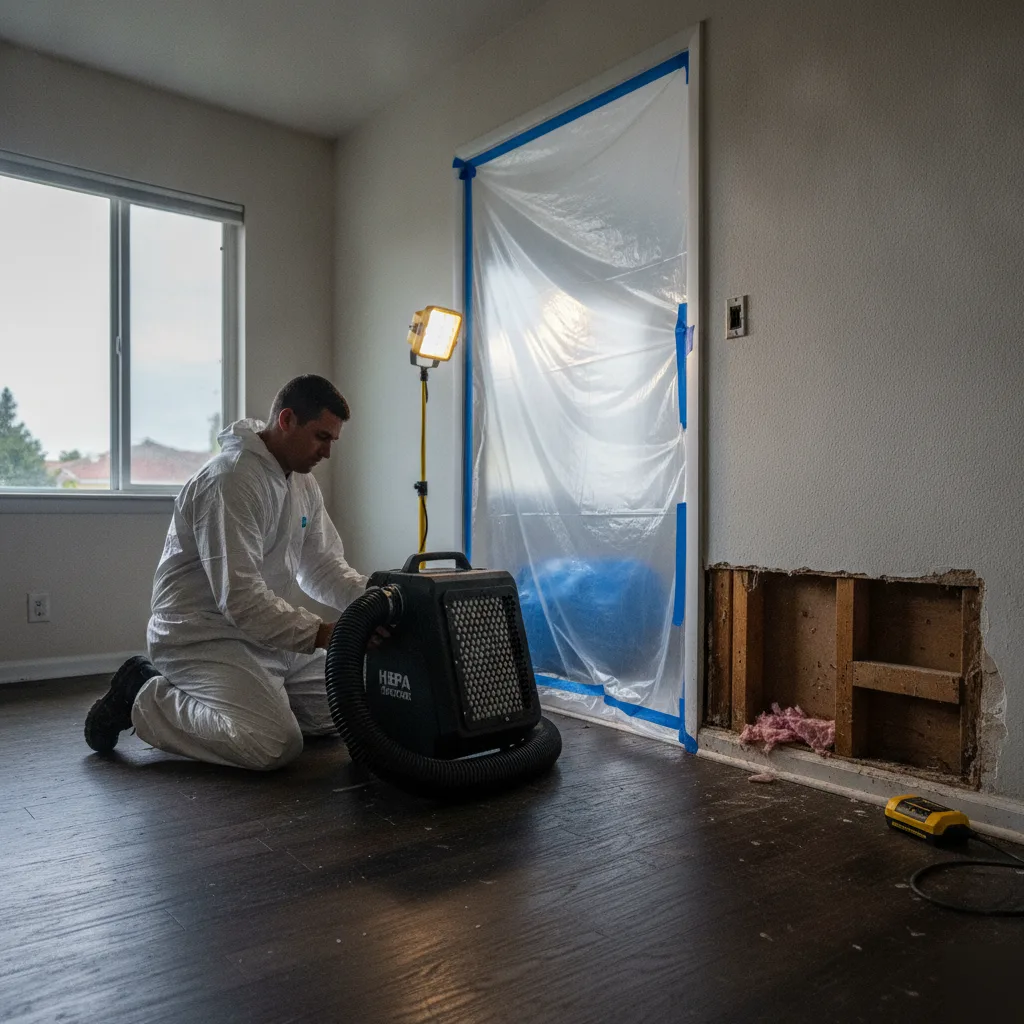
Nobody tells you this: turning on a HEPA machine in an open room can make things worse. If mold spores are airborne and there is no barrier around the work area, that scrubber just pulls air from the whole house through it — stirring up spores that were sitting still. We have walked into jobs where a well-meaning owner ran a rented air scrubber for two days straight with no containment, and the smell had spread to rooms that were clean before.
Mold containment has to go up first. That means sealing the work area with plastic sheeting, taping off HVAC vents, and setting up negative air pressure. This pulls contaminated air out — not further into the house. Only then does the HEPA unit start doing real work.
Seal the Affected Area
Poly sheeting and zip walls create a physical barrier between the contaminated zone and clean living spaces.
Shut Down or Isolate the HVAC System
Ducts running through the containment zone are sealed so spores cannot hitch a ride into adjacent rooms while the scrubber runs.
Set Negative Air Pressure
The containment zone is set to slight negative pressure, ensuring any air movement is inward — not outward into clean areas.
Run the HEPA Air Scrubber
The HEPA unit now pulls contaminated air through filtration down to a fraction of a micron, clearing spores, smoke particulate, and odor-carrying particles.
Antimicrobial Treatment on Surfaces
Once the air clears, EPA-registered antimicrobial treatment is applied to affected structural surfaces before containment comes down.
Rose Garden and Naglee Park homes — take note: Original ductwork often runs through crawl spaces with limited sealing. A leaky duct can pull spore-laden air straight into living areas the moment a scrubber creates pressure changes. Our crews check duct paths before setup, not after.
Skip containment and you are not remediating — you are redistributing.
How Air Scrubbing Costs Are Structured in Restoration Jobs
Air scrubbing is almost never sold as a flat, stand-alone fee in a legitimate restoration estimate. Instead, it is priced as a per-unit, per-day line item — nested inside the broader mitigation scope alongside water extraction, containment, and structural drying. The estimate typically lists the number of HEPA units deployed, the daily rate for each, and the number of days they ran.
Several factors drive the final number. Room size and ceiling height determine how many units are needed to achieve adequate air changes per hour. A single scrubber rated for a bedroom will not clear a great room or an open-concept downtown loft. Contamination severity matters too — a Category 3 water loss or active mold remediation demands longer run times and often negative-air containment barriers.
Questions to Ask Before You Sign the Invoice:
- Ask for the number of HEPA units deployed and the daily rate charged per unit.
- Request documentation showing why containment barriers were necessary for your specific loss.
- Confirm whether air scrubbing days are tied to actual moisture or air quality readings — not a flat estimate.
- Get an itemized, insurance-ready invoice that separates equipment, labor, and containment materials.
The goal is a scope tied to documented conditions, not a padded line item. A well-prepared San Jose restoration company will hand over readings, photos, and daily logs that match the invoice — giving both the homeowner and the insurance adjuster a clear paper trail for every unit-day billed.
Call 408-202-9356 for a Free EstimateCommon Questions About Air Filtration & HEPA Scrubbing
Common questions about Air Filtration & HEPA Scrubbing
How fast can you get a HEPA air scrubber set up in San Jose?
We are locally based in San Jose and answer calls 24/7, so we can get equipment moving fast after a mold, fire, or flood event. A free on-site estimate comes first, where we check moisture levels and air quality before recommending scrubbing equipment. Response speed matters most after sewage backups or hidden leaks, since spores spread through your HVAC system quickly. The sooner we assess the space, the sooner clean air comes back to your home.
What happens when your team arrives to do air scrubbing?
We start by checking the source of the problem — whether it is mold, smoke, or water damage — before running any equipment. This matters because smoke-driven air issues need a different approach than mold or sewage contamination. We test moisture levels, look at your HVAC filter rating, and check for settled particulate in carpets or ductwork. One team handles the full job, from extraction and drying through air filtration, so you are not juggling separate crews.
Why does San Jose smoke season affect my indoor air even with windows closed?
Wildfire smoke from the Santa Cruz Mountains or Diablo Range pushes PM2.5 particles into homes through door gaps, aging weatherstripping, and HVAC systems pulling outdoor air. Many San Jose homes near Willow Glen, Almaden, and downtown were built in the mid-century through 1970s with standard 1-inch fiberglass filters. These filters do not stop fine smoke particulate, so odor and haze settle into carpets and drywall even when your house stays sealed up during a fire event.
Do I need a professional HEPA scrubber or can I just run a store-bought air purifier?
A store-bought purifier or a MERV-13 HVAC filter upgrade is often enough for general wildfire haze or everyday dust sensitivity. This is common in older Rose Garden or Naglee Park bungalows with leaky duct seals. But if you have had mold remediation, sewage cleanup, or a moisture meter reading above normal, that is a contamination event, not a filtration problem. Professional HEPA scrubbing clears out what containment treatment leaves floating in the air after those bigger jobs.
How do I know if a musty smell needs professional air scrubbing or just fresh air?
If the smell clears within a day of opening windows and running a fan, it is usually just a closed-up room needing airflow. But if it traces back to water damage, or returns within a day or two after you have aired the house out, that points to mold or moisture trapped behind walls. Coughing, headaches, or sinus irritation that eases once you leave the house is another sign the air itself needs treatment, not just ventilation.
Should I treat wildfire smoke and mold air problems the same way in San Jose?
No, these are two separate issues that need different responses. Wildfire smoke gets in through gaps, weatherstripping, and low-rated HVAC filters, and it does not require standing water or a moisture source. Mold and sewage contamination spread through your ductwork after a leak or backup and need containment plus HEPA scrubbing. Homes built before the 1980s in San Jose often have both risks, so it is worth getting each cause checked separately during an assessment.
Emergency Water Damage?
Pay Zero Upfront.
Direct insurance billing on covered claims with no hidden catch. Get immediate water damage repair & extraction in San Jose today. Contact us to book a free on-site estimate!
Feel Free to Contact Us or Book Services
First Response: Your best solution for accurate, immediate, and professional help for all your water damage repair and restoration needs in San Jose and Silicon Valley.
- 24/7 Friendly Support
- Professional IICRC-Certified Specialists
- 15+ Years Local Experience in San Jose
- Direct Insurance Billing & Itemized Claims
- Same-Day Water Damage Extraction